Four-team requirement
Total War requires four complete squads, so roster depth matters more than simply owning one premium lineup.
Total War is one of the most demanding endgame modes currently available in Kaiju No. 8 The Game. Instead of letting you solve content with one or two optimized squads, it forces you to build four separate teams, manage your roster depth, distribute supports correctly, and break boss plates fast enough to convert each five-turn stage into a strong score. If you still need a baseline for building squads, start with our Best Teams guide and compare it against your current roster.
Last update: April 27, 2026
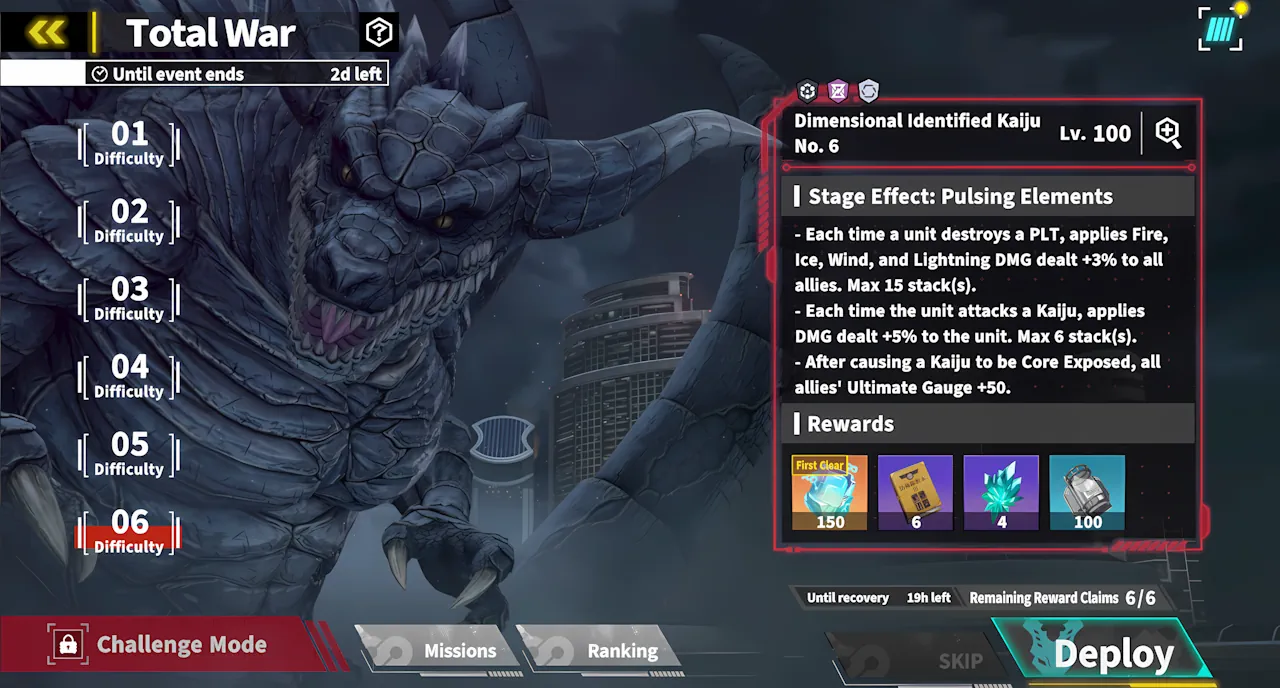
Total War is a score-focused multi-squad mode where you clear a sequence of boss encounters with four different lineups. It is one of the first systems in the game where roster breadth matters as much as raw unit quality. Owning a few meta characters from the Tier List is no longer enough if the rest of your account cannot cover plate breaking, support distribution, and survivability across four stages.
In practice, Total War is a combined roster check, resource check, and execution check. The players who do best are usually the ones who invest broadly, manage Uniparts intelligently, and understand when to prioritize speed over greedy damage setups.
Right now the boss is Kaiju N.6, so the mode’s core mechanics revolve around his kit and the best ways to break his plates, manage his waves, and optimize damage during his exposed windows.
The biggest takeaway is simple: speed and plate-break efficiency matter more than raw DPS. A team with decent damage but weak break tools will reach the boss’s exposed window too late and lose score, while a faster team with cleaner plate pressure will usually outperform it.
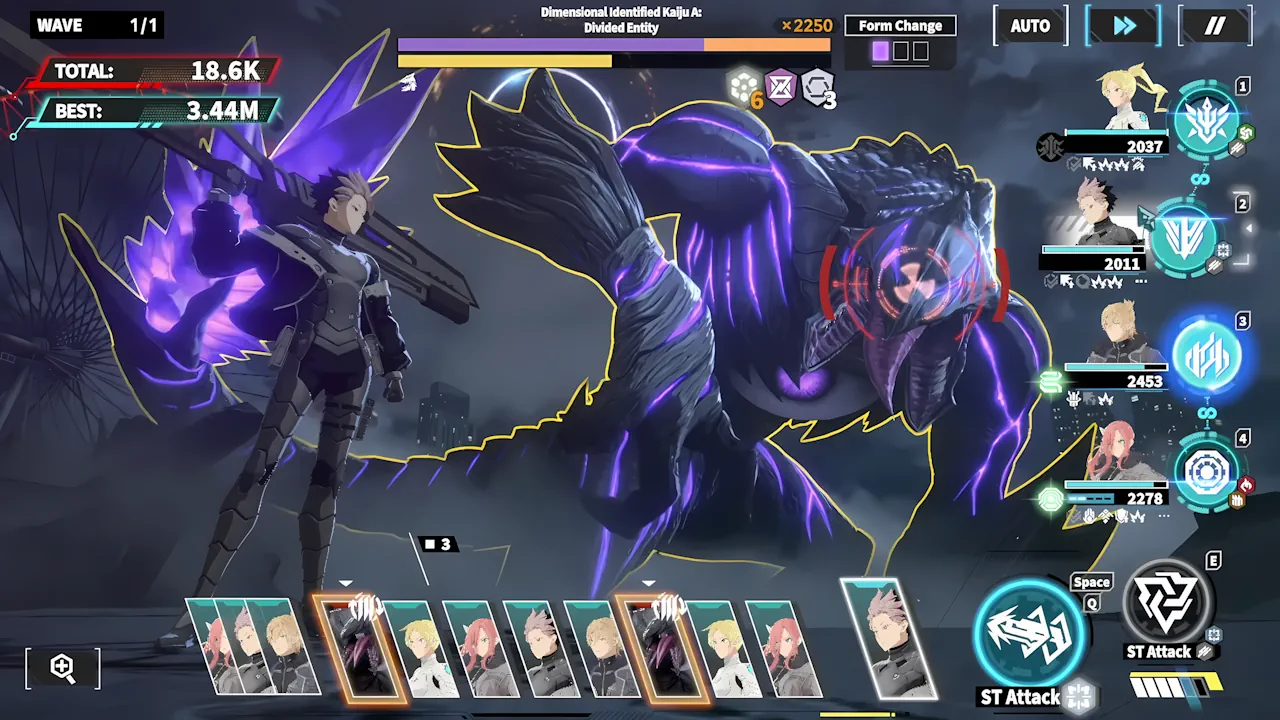
Total War requires four complete squads, so roster depth matters more than simply owning one premium lineup.
Every plate broken grants +4% damage dealt, stacking up to 15 times, so break speed is the mode’s main scaling mechanic.
Once the boss is exposed, your team gains +50% Action Order and +20% Special Move Gauge Rate for explosive burst turns.
Short stages punish slow setups, bad rotations, and wasted skills. Every action has direct score impact.
Auto mode is a major handicap in Total War. The AI regularly wastes combat skills, uses ultimates at the wrong time, and breaks plates inefficiently. That is a problem in any mode, but it becomes much worse here because every stage only lasts five turns.
One bad action can cost exposed uptime, ultimate timing, and a large amount of score. For casual clears, auto may still be usable. For ranking, manual play is strongly recommended.
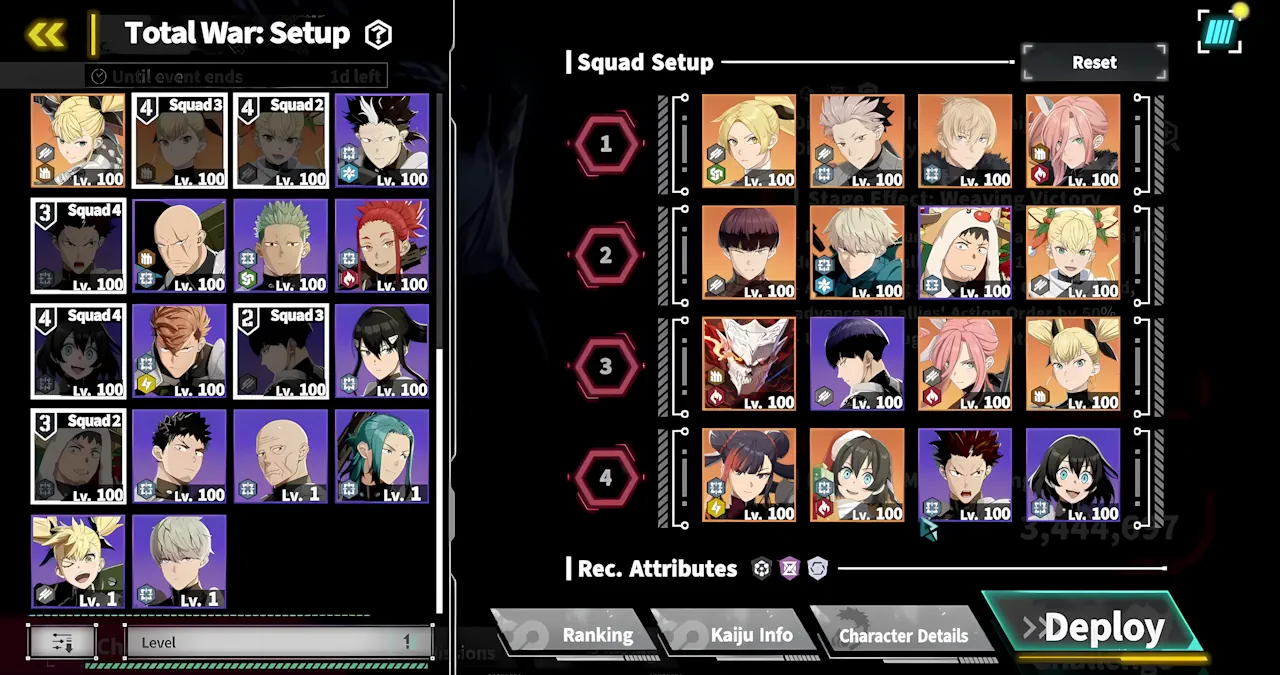
Each team should ideally have at least two units that can break plates reliably, or the boss will stay protected for too long.
One overbuilt squad and three weak squads performs worse than four functional teams with shared investment and coverage.
Healers and universal supports are limited, so you often have to trade damage, survivability, and break pressure between squads.
Boss AoE, focused damage, and limited sustain can ruin a run even if the damage profile looked good on paper.
Every team should ideally have at least two units capable of efficient plate breaking.
If you are missing role coverage, review your available units in the character list and rebuild each squad around breakers first, then supports, then damage finishers.
The best teams attack plates immediately and reach Exposed State with minimal setup time.
High-value teams convert the exposed window into ultimates, fast rotations, and direct score gain.
Short fights reward teams that deliver buffs early rather than compositions that need a long ramp.
Long-ramp passives and delayed damage engines usually underperform because the stage ends before they peak.
Uniparts matter more than usual because the fights are so short. The best-performing sets are the ones that provide immediate value: faster ultimate charge, stronger opening tempo, and more reliable plate breaking. Wyvern B stands out as one of the most useful examples because it helps teams accelerate their early rotation instead of waiting for slow scaling. If you want to compare set options in more detail, check the full Uniparts guide.
This is also why some teams underperform even when their raw DPS looks acceptable. If they lack speed, dual attackers, or proper support sequencing, they hit Exposed State too late and their damage profile arrives after the score window has already collapsed. In many cases, fixing the lineup itself through the team-building page matters more than forcing better stats.
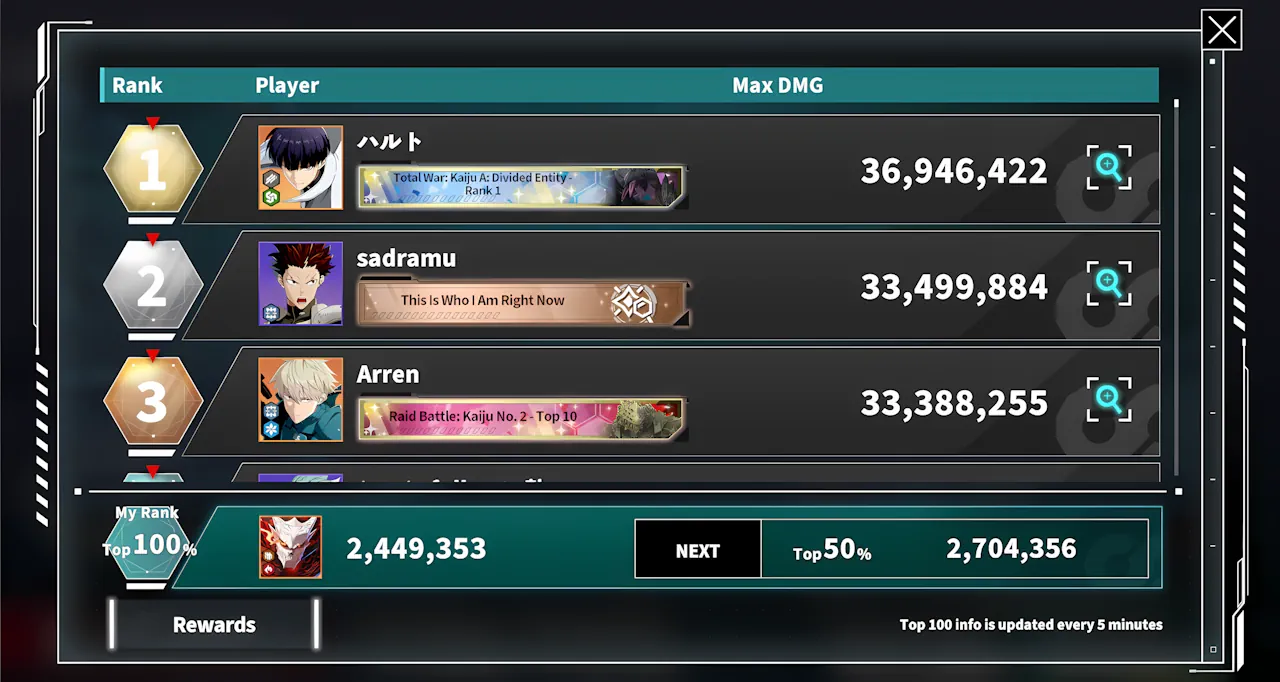
Total War is a ranking mode, so your final score determines your reward bracket. The reward jump between middle and high ranks is not always dramatic unless you are pushing near the top, which creates two very different ways to approach the mode.
Focus on stable clears, four functional teams, and efficient rewards. This is the best approach for most accounts.
Optimize manual sequencing, plate control, ultimate timing, and restart quality to squeeze every possible point.
Check plate breakers first. Before refining damage, confirm every squad can reach Exposed State quickly.
Spread your best supports carefully. Do not overload one lineup if it makes the other three unstable.
Prioritize tempo Uniparts. Fast-gauge and early-turn value outperform slow scaling in this mode.
Play manually for ranking. Five-turn stages are too strict for auto when score quality matters.
Total War is one of the most interesting progression checks in Kaiju No. 8 The Game so far. It is not just a damage race. It tests whether your account can field four competent teams, whether your units are distributed correctly, and whether you can play short score windows cleanly.
More than anything else, the mode rewards players who build beyond one or two meta squads. If you optimize break speed, spread your supports intelligently, and play manually when score matters, Total War becomes one of the clearest indicators of real account progression.